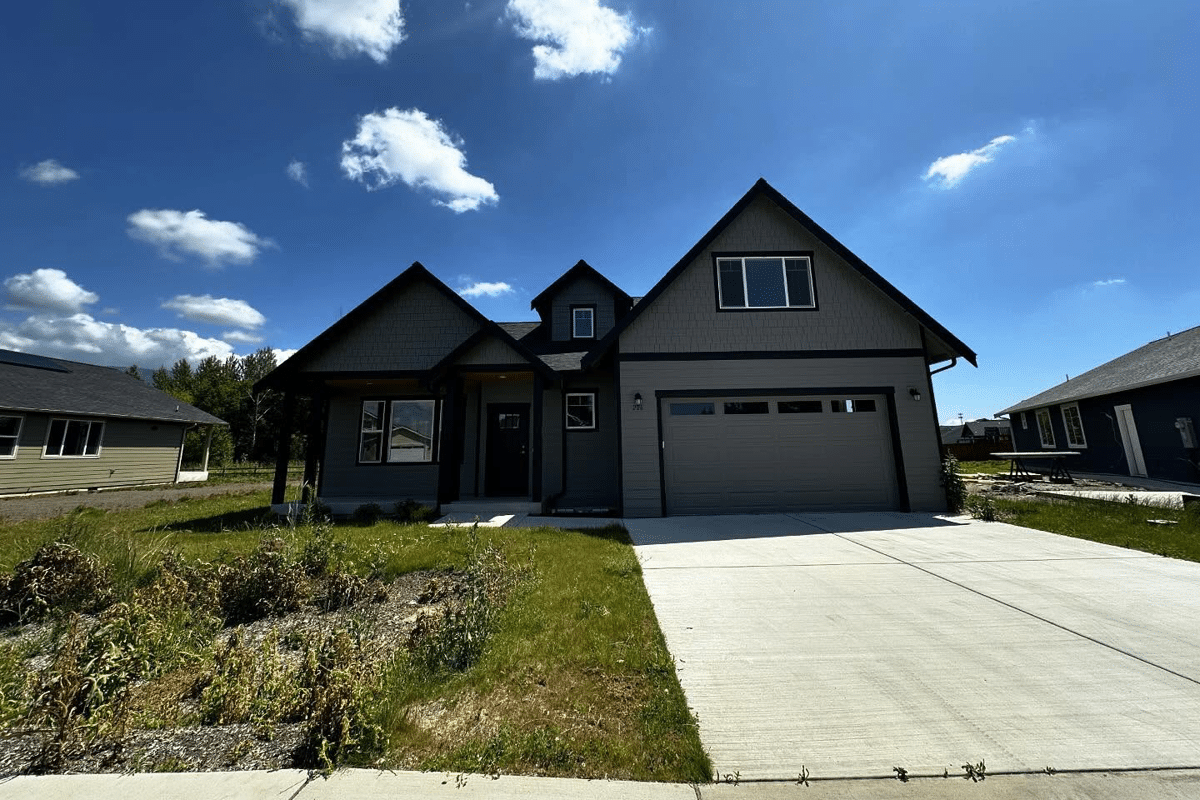
Before discussing why fiber cement siding’s wet-climate performance matters, it helps to understand the problem. Western Washington isn’t just rainy. It’s relentlessly and consistently wet, with a brief dry stretch in July and August, followed by nine-plus months of continuous moisture.
That sustained exposure is what separates this climate from almost everywhere else in the country. Installing James Hardie siding in Pacific Northwest homes requires precision, as materials that perform well in milder climates can still fail here without proper installation. Siding designed for occasional rain in drier climates lacks the durability profile for this level of exposure.
What Happens to Wood in This Climate
Wood siding absorbs moisture. That’s just its nature. When it gets wet repeatedly without enough time to fully dry out, it swells, pulls at fasteners, and starts feeding rot. Paint cracks along the grain. Joints open up. By year five or six in a damp location, wood siding often shows real wear: warped boards, peeling finish, soft spots near trim and windows.
Fiber cement vs wood siding performance in wet climates isn’t even close once you’ve seen both materials age side by side out here.
How Fiber Cement Handles Constant Rain
Fiber cement is made from a mix of cement, sand, and cellulose fibers. That composition makes it dimensionally stable. It doesn’t swell, shrink, or warp when it gets wet. Water hits the surface and runs off rather than soaking in.
Why Hardie Board Moisture Resistance Matters
Hardie board moisture resistance goes beyond the material itself. The way each plank sits on the wall, how it’s lapped, where it’s nailed, and how the seams and edges are sealed all determine how much water actually reaches the sheathing behind it.
When properly installing fiber cement in our climate, the details matter as much as the product:
- Nail placement at the correct height, not through the face, not driven too deep
- Adequate clearance from rooflines, decks, and grade
- Sealed butt joints at every horizontal seam
- Flashed and caulked window and door surrounds
- Moisture-resistant end-cut treatment on every field cut
Miss any of those, and water finds a way in regardless of how good the panel is. Get them all right, and your exterior walls stay dry for decades.
A lot of siding gets painted on-site. Crews brush or spray it onto boards that may be slightly damp, in variable temperatures, with paint that has to cure outdoors. Even with quality coats, that finish is fighting the conditions from day one.
James Hardie ColorPlus works differently. The color is baked on at the factory under controlled conditions with multiple coats and a final baked sealant. By the time the plank arrives on your job site, the finish is already fully cured and consistent across every board.
What That Means in Practice
In a rainy climate, field-applied paint starts showing wear sooner. Low winter sun, constant moisture, and temperature swings break down the paint film over time. ColorPlus resists that. It holds color longer, resists fading and chipping, and doesn’t need repainting nearly as often.
For homeowners who’ve already gone through a paint-and-repaint cycle every few years, that factory finish alone is worth a serious look.
Here’s something that doesn’t get talked about enough: even fiber cement can fail if it’s installed flat against the sheathing without a drainage plane. Moisture that gets behind the cladding, through a failed caulk joint, wind-driven rain, or condensation, needs somewhere to go.
Rainscreen siding detailing creates that path. A small gap between the back of the plank and the weather barrier allows water to drain down and out rather than sit against the wall. Air can move through that gap and help the assembly dry. Without it, moisture accumulates, and over years that leads to problems even with a durable material.
Getting Fastening Right
The fastening side of the installation matters too. Fiber cement is heavier than wood or vinyl, so it needs proper support. Nails or screws need to hit studs, be driven to the correct depth, and be spaced correctly along each plank.
As a James Hardie Alliance Elite contractor, our team at Laika Construction follows manufacturer specs on fastening, flashing, and joint treatment on every project. You can see how this fits into our full siding services and our work across Bellingham and Whatcom County.
Standing Up to Moss and Algae
Moss loves our north-facing, shaded walls. It latches onto rough, porous surfaces and slowly breaks down what’s underneath. Wood gives it plenty to work with. Fiber cement doesn’t.
The smooth factory surface and hard exterior of fiber cement give moss very little to grip. Biological growth can still accumulate on any surface here if it’s shaded and damp, but it cleans off far more easily and does less damage.
Keeping It Clean Long-Term
A low-pressure rinse once or twice a year handles most buildup on fiber cement. Some homeowners add zinc strips along the roofline to slow algae regrowth. You don’t need aggressive pressure washing, and you’re not dealing with soft, rotting boards underneath the stain. That’s a fundamentally different maintenance picture than wood siding in this region.
When you put the whole picture together, moisture resistance, factory finish, correct rainscreen detailing, and resistance to moss, James Hardie siding in Pacific Northwest homes comes into clear focus. This cladding was engineered for climates like ours, and when it’s installed correctly, it protects a home for 30 to 50 years with comparatively little intervention.
That’s the difference between siding that’s fine and siding that’s right for where you actually live.